In the fourth grade of Waldorf education there is a lesson block that looks at the relationship between humans and the rest of animal creation. I had a hard time making sense of it. Having been taught something very different in my grade school days (ideas that have not served well, by the way) it was a whole new perspective to explore, and the full-on Anthroposophic Steiner model didn't work for me. The more I got into it, tho', I could see the core parts were good, and they integrate well with our Eastern Christian understandings.
For further reading to understand better the Waldorf/Steiner mode of seeing this topic, the
book "The Human Being and the Animal World" by Charles Kovacs is
especially good at delving into it. This blog post from Five of Us does a decent job of summarizing.
Of course, this is a natural opportunity to include the idea of
humanity as the truest icons of the Divine, and that may lead into a
further lesson about what icons are and how we use them. I particularly like this blog post on the topic.
This intro to the difference between human and animals helps support and make some important underlying foundational concepts that are needed in Eastern Christianity:
-- understand the nature of the flow of the spirit through our bodies will be useful later on when breathing & spiritual practice are taught
-- the beauty of the head, trunk, limbs metaphor is
not lost later on when we learn about the purpose of humanity in God's
creation
-- no judgement is placed on the rest of God's creation as lesser or lacking, just functionally and different in purpose
-- it also does not overemphasize intellect as tho' that is our most important tool; this sets up the importance of thinking and listening from the heart, and not accidentally giving the intellect and "monkey mind" too much significance
Here are
the beginning pages to our block (the following pages are physical animal studies and observations).
the pursuit of the natural lifestyle in a commercial society -- creativity, eating well, homeschooling, o/Orthodoxy, parenting, homemaking, and such
Showing posts with label religion. Show all posts
Tuesday, April 12, 2016
Thursday, December 3, 2015
Making a Vertical, Wall-Hung Phillipian Star for the Advent Fast
In the Eastern Christian tradition we have a six week fast right before Christmas. This Advent time fast is called the Phillipian Fast, or Phillipo Fast or Philopovka, because it starts on St Phillip's feast day, Nov 14th. One of the ways we mark this time is through a candle holder in the shape of a six sided star. A new candle is lit each week, and the special candle in the middle is for Christmas Eve and maybe Christmas day. Some traditions have a different color candle for each week with a matching quality to meditate on that week, and others have all red candles for the weeks and a gold one in the center. There are lovely readings and prayer services that you can do along with your family during this time and at the lighting of the candles.
In past years, we've a style of candle holder made of wood it holds lovely tapers and makes a striking centerpiece. Nothing compares to the warm, focusing glow of candlelight. One of my more recently mobile children has not figured out candle etiquette, and altho' we didn't have difficulties with our older children around matches and fire, this little one makes having flame about a problem. We all seven of us live in a very small house (less than 1000sqft of living space), so space is at a premium, especially on the only table.
A friend came up with the thought of having a Phillipian Star that hung on the wall. What a great idea! But how? and wouldn't the flames of the candles on the bottom melt the candles above extra quickly? And how, and of what materials, could you make a wall scone in that shape that wasn't a fire hazard? More importantly, how could I do it with the skills I already have and on a budget?
I mulled it over for a while, and then it came to me: fake candles! Those battery operated candles, some needle and thread, some glue and materials and *voila* easy-peasy. As I went I modified it to be even easier! and I didn't need to whip out a lot of tools, and it took only 20 minutes to make. Even better: I got everything at the dollar store. Yup, you read that right -- super effective & cheap project.
1) The ribbon was glued onto the round place-mat with fabric glue. It took a little math to get the geometry and placement right, and you do need to allow time for the glue to dry. We did some book reading & kitchen cleaning while it dried.
2) I measured ribbon to go around the side of the tealights to make a loop, careful to singe/melt the edges on a real candle (best anti-fray ever). At first I glued the loops together, but it took too much time, Simple tacking them with a needle & thread by hand was much faster.
3) Sew on the loops in place at the points of the star by just a few stitches only at the top so that the loops hang down. The faux candles are light-weight and not creating a lot of tension/pull so it doesn't take much. This way, too, it's easy to slide them into the loops (or replace them later as need be), and easy to get to the little stitches to turn them on or off.
4) I used a staple gun to attach it right to the wall. I also added a bit of left over gold glitter paint to the ribbon lines that make the star and to the center candle. Done! and out of the reach of little hands, no fire-hazard, and still visually striking.
We use ours with six red candles around the edged and a golden one in the middle. The tealights themselves are white, so I made the colors by the ribbons, You could also paint the tops of the tealights if you want -- they take paint remarkably well. I found some tealights that had red glitter on them like little peppermint candies, so I got some of those for the red candle spots after Thanksgiving for the weeks of December -- because glitter makes everything better *wink*.
In past years, we've a style of candle holder made of wood it holds lovely tapers and makes a striking centerpiece. Nothing compares to the warm, focusing glow of candlelight. One of my more recently mobile children has not figured out candle etiquette, and altho' we didn't have difficulties with our older children around matches and fire, this little one makes having flame about a problem. We all seven of us live in a very small house (less than 1000sqft of living space), so space is at a premium, especially on the only table.
A friend came up with the thought of having a Phillipian Star that hung on the wall. What a great idea! But how? and wouldn't the flames of the candles on the bottom melt the candles above extra quickly? And how, and of what materials, could you make a wall scone in that shape that wasn't a fire hazard? More importantly, how could I do it with the skills I already have and on a budget?
I mulled it over for a while, and then it came to me: fake candles! Those battery operated candles, some needle and thread, some glue and materials and *voila* easy-peasy. As I went I modified it to be even easier! and I didn't need to whip out a lot of tools, and it took only 20 minutes to make. Even better: I got everything at the dollar store. Yup, you read that right -- super effective & cheap project.
![]() | |
| tools needed: round place-mat, ribbons, hand sewing needle and thread, scissors, glue, battery t | ealight candles |
1) The ribbon was glued onto the round place-mat with fabric glue. It took a little math to get the geometry and placement right, and you do need to allow time for the glue to dry. We did some book reading & kitchen cleaning while it dried.
2) I measured ribbon to go around the side of the tealights to make a loop, careful to singe/melt the edges on a real candle (best anti-fray ever). At first I glued the loops together, but it took too much time, Simple tacking them with a needle & thread by hand was much faster.
![]() |
| the loops of ribbon around the tealights are tacked on only at the top so that it can be lifted to turn the candle on & off |
3) Sew on the loops in place at the points of the star by just a few stitches only at the top so that the loops hang down. The faux candles are light-weight and not creating a lot of tension/pull so it doesn't take much. This way, too, it's easy to slide them into the loops (or replace them later as need be), and easy to get to the little stitches to turn them on or off.
4) I used a staple gun to attach it right to the wall. I also added a bit of left over gold glitter paint to the ribbon lines that make the star and to the center candle. Done! and out of the reach of little hands, no fire-hazard, and still visually striking.
![]() |
| the finished product! |
We use ours with six red candles around the edged and a golden one in the middle. The tealights themselves are white, so I made the colors by the ribbons, You could also paint the tops of the tealights if you want -- they take paint remarkably well. I found some tealights that had red glitter on them like little peppermint candies, so I got some of those for the red candle spots after Thanksgiving for the weeks of December -- because glitter makes everything better *wink*.
Monday, November 16, 2015
Orthodox Nativity Study for the Advent Season
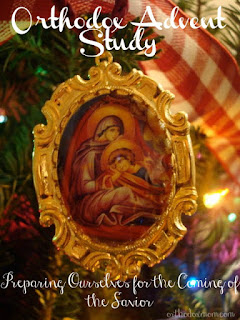
This year, I am going through this book of reflections: Orthodox Advent Study by Sylvia Leontaritis who is the blogger at Orthodox Mom. Our season of preparation towards the Feast of the Nativity, The Incarnation, begins mid November so we have a little extra time in our Eastern tradition to get into things.
Described as, "This 66-page eBook was created with the hope of assisting us to overcome the spirit of secularism by offering some simple things to ponder every day during the next six weeks. We’ll also discuss some common misconceptions (Was it a stable or a cave? Were Mary and Joseph betrothed or married?) that will help us gain a better understanding of what really happened that holy night so many years ago in the city of Bethlehem.
Included in this Advent Study are weekly devotionals, daily readings, and activities to help us remember who and what we are really celebrating at Christmastime."
The thing I like the most is that each reflection is _short_. I'm a busy mom of five kids with a husband who provides for us by working many many hours -- getting time for basic self-care like a shower is nearly impossible so I am definitely not going to be able to get into depth with deeper readings, nor get all tied into learning & researching some deeper theology (much tho' I would love to). The things presented here are partly reading scripture and writing your own short reaction/reflection to it (right on the page in the book -- no extra work or finding other pages or journal), and also thrown in are learning thing form our holy tradition (like, what is the symbolism of a particular related icon, and there are even some recipes for festive treats at the end.
Described as, "This 66-page eBook was created with the hope of assisting us to overcome the spirit of secularism by offering some simple things to ponder every day during the next six weeks. We’ll also discuss some common misconceptions (Was it a stable or a cave? Were Mary and Joseph betrothed or married?) that will help us gain a better understanding of what really happened that holy night so many years ago in the city of Bethlehem.
Included in this Advent Study are weekly devotionals, daily readings, and activities to help us remember who and what we are really celebrating at Christmastime."
The thing I like the most is that each reflection is _short_. I'm a busy mom of five kids with a husband who provides for us by working many many hours -- getting time for basic self-care like a shower is nearly impossible so I am definitely not going to be able to get into depth with deeper readings, nor get all tied into learning & researching some deeper theology (much tho' I would love to). The things presented here are partly reading scripture and writing your own short reaction/reflection to it (right on the page in the book -- no extra work or finding other pages or journal), and also thrown in are learning thing form our holy tradition (like, what is the symbolism of a particular related icon, and there are even some recipes for festive treats at the end.
Monday, October 19, 2015
St Elizabeth the Wonderworker and the Dragon; Waldorf Ideas
If you are not familiar with Elizabeth the Wonderworker, taker a moment
to look her up. She is a fascinating and influential
character -- she is both a gentle healer, and a wielder of powerful presence. In the Eastern Christian tradition, her feast
day and the feast day of St George are in the Springtime.
In the Waldorf calendar of seasonal celebrations, the story of Saint Elizabeth fits in nicely in the Fall/Autumn since she was a dragon slayer, and that is the story soul-quality for the Waldorf seasonal celebration of Michaelmas. People who wish to show more examples of female saints will find that her story fits in perfectly. This story may appeal to some for it's lack of violence: she used no weapons in her interactions with the dragon. While in the original story the dragon does die in the end, it can be varied variation for more sensitive minded/hearted children who have a hard time with the dragon dying. Saying the she "subdued the dragon" will not change the soul-quality of the story, nor change the seeds planted for personal growth later in life.
Below are some ideas about how to make a festival with her as the focus, as well as a version of the dragon story. You will find that many Michaelmas dragon type crafts also fit in well here, and you can find many other dragon themed crafts on the web that might be appropriate.
Ideas for celebrating:
-- This story lends itself very well to a puppet show.
-- Make dragon bread.
-- Make a dragon out of clay.
-- Dress up as Saint Elizabeth and walk around barefoot inside and outside. Walk around and explore different terrains and textures.
-- Perform a play of the story.
-- Make a painting, chalk, or crayon drawing of Elizabeth and the dragon.
-- Consider eating a meal of foods from Greece or Turkey, the regions in which she lived (Thrace).
A Story of St Elizabeth The Wonderworker and the Dragon
Elizabeth was a talented and holy woman who knew from early on that she had a special mission in life to be a nun and to help people. Elizabeth worked and studied all her life to make her abilities strong and focused. She was extra gentle and kind to everyone, and very tender-hearted towards those who were sick or hurt. She knew healing arts, and helped many people become well again. She healed both their hearts and their bodies. The group of holy women she lived with looked to her for guidance, and people from all over traveled to seek her wisdom.
The emperor of the land was so grateful for all the good things this group of women did that he gave them a piece of land to make their home where they could live and people could come to for help. Before they moved there, they learned that there was a terrible dragon that lived there in a cave. The dragon made people scared & afraid, and filled their hearts with despair. But Elizabeth did not feel despair nor any fear. She confidently walked in her bare feet right up to the cave with nothing else; no tools and no weapons -- just the surety of God and knowledge of what is rightful. Elizabeth boldly called "Dragon! COME OUT!" and the dragon obeyed her! The fierce-some and surly dragon slithered out and in stood front of her. Elizabeth made the sign of the cross over the dragons head and the dragon immediately became calm. She placed her bare foot on the dragons head and subdued it.
In second grade the story of St Elizabeth the Wonderworker might be added as one of the main lesson block stories. You can find out more of her story by searching online as well as other pictorial depictions of her and her life. Here is the main lesson book entry and picture of my second grader:
In the Waldorf calendar of seasonal celebrations, the story of Saint Elizabeth fits in nicely in the Fall/Autumn since she was a dragon slayer, and that is the story soul-quality for the Waldorf seasonal celebration of Michaelmas. People who wish to show more examples of female saints will find that her story fits in perfectly. This story may appeal to some for it's lack of violence: she used no weapons in her interactions with the dragon. While in the original story the dragon does die in the end, it can be varied variation for more sensitive minded/hearted children who have a hard time with the dragon dying. Saying the she "subdued the dragon" will not change the soul-quality of the story, nor change the seeds planted for personal growth later in life.
![]() |
| In this icon you can see the cave of the dragon on the background and Elizabeth's bare foot on the dragon's head. |
Below are some ideas about how to make a festival with her as the focus, as well as a version of the dragon story. You will find that many Michaelmas dragon type crafts also fit in well here, and you can find many other dragon themed crafts on the web that might be appropriate.
Ideas for celebrating:
-- This story lends itself very well to a puppet show.
-- Make dragon bread.
-- Make a dragon out of clay.
-- Dress up as Saint Elizabeth and walk around barefoot inside and outside. Walk around and explore different terrains and textures.
-- Perform a play of the story.
-- Make a painting, chalk, or crayon drawing of Elizabeth and the dragon.
-- Consider eating a meal of foods from Greece or Turkey, the regions in which she lived (Thrace).
A Story of St Elizabeth The Wonderworker and the Dragon
Elizabeth was a talented and holy woman who knew from early on that she had a special mission in life to be a nun and to help people. Elizabeth worked and studied all her life to make her abilities strong and focused. She was extra gentle and kind to everyone, and very tender-hearted towards those who were sick or hurt. She knew healing arts, and helped many people become well again. She healed both their hearts and their bodies. The group of holy women she lived with looked to her for guidance, and people from all over traveled to seek her wisdom.
The emperor of the land was so grateful for all the good things this group of women did that he gave them a piece of land to make their home where they could live and people could come to for help. Before they moved there, they learned that there was a terrible dragon that lived there in a cave. The dragon made people scared & afraid, and filled their hearts with despair. But Elizabeth did not feel despair nor any fear. She confidently walked in her bare feet right up to the cave with nothing else; no tools and no weapons -- just the surety of God and knowledge of what is rightful. Elizabeth boldly called "Dragon! COME OUT!" and the dragon obeyed her! The fierce-some and surly dragon slithered out and in stood front of her. Elizabeth made the sign of the cross over the dragons head and the dragon immediately became calm. She placed her bare foot on the dragons head and subdued it.
In second grade the story of St Elizabeth the Wonderworker might be added as one of the main lesson block stories. You can find out more of her story by searching online as well as other pictorial depictions of her and her life. Here is the main lesson book entry and picture of my second grader:
![]() |
| (In this case, the different colored words do not have a purpose -- my young student just "wanted it to be pretty") |
Wednesday, February 25, 2015
Do Not Deny Your Body! The Great Fast
I hope the title of this blog article caught your attention; it's meant to. But what do I mean by that?
It is that time of year when people are participating in the Great Fast (Lent) in preparation towards Pascha (Easter). The inevitable conversations and questions come up about the rules, the guidelines, what we are allowed to eat, and so forth. These things are good, as they give us a baseline to try from, but they are not the end goal of fasting. And if you already eat in this way (perhaps you are a vegan), you might have met the guidelines, but they don't serve you as tool towards growth. Or, you are able to eat veggie burgers instead of hamburgers, or make the perfect vegetarian cake from categories of foods that are "fast friendly" -- you have denied the spirit and usefulness of fasting by only looking at the letter of the law.
Your body needs nutrition to work properly, and the different stages, ages, and genders of your family members may need different physical nourishment to fulfil that. Are you a physical laborer? You cannot deny your body the proper fuel to make a living and support your family, and do your duty as a good worker. Are you a mother? Your ascetic life requires constant self denial and your bodily resources are used to nourish others; often literally! Are you a child? Your job right now is to learn and grow. Do you already have physical and health challenges that make life difficult? Do not worsen them by choosing a poor diet, even if it's temporary.
Do not deny the body what it needs -- the fast is not meant to deny the body, it is meant to deny the ego; it is meant to deny passion's control over you. If you make yourself sick, tired, ill, or lacking in energy, how will you fulfill your vocation in life? Be good to your body -- it is a valuable, sacred tool to be respected & loved. Do not allow your fasting understanding to become a semi-gnostic understanding of the body being bad, and the physical something to punish.
Let us not be pharisaic about the fast, desperately seeking the easy road of following the letter of the law: "Do not eat this; eat this" will not help you in your path. It is simply a tool to help you remember the power of your will, and your ability to direct your will towards that which it is most meant for: your vocation in life that leads you towards greater union with God, and union with one another in God.
It is that time of year when people are participating in the Great Fast (Lent) in preparation towards Pascha (Easter). The inevitable conversations and questions come up about the rules, the guidelines, what we are allowed to eat, and so forth. These things are good, as they give us a baseline to try from, but they are not the end goal of fasting. And if you already eat in this way (perhaps you are a vegan), you might have met the guidelines, but they don't serve you as tool towards growth. Or, you are able to eat veggie burgers instead of hamburgers, or make the perfect vegetarian cake from categories of foods that are "fast friendly" -- you have denied the spirit and usefulness of fasting by only looking at the letter of the law.
Your body needs nutrition to work properly, and the different stages, ages, and genders of your family members may need different physical nourishment to fulfil that. Are you a physical laborer? You cannot deny your body the proper fuel to make a living and support your family, and do your duty as a good worker. Are you a mother? Your ascetic life requires constant self denial and your bodily resources are used to nourish others; often literally! Are you a child? Your job right now is to learn and grow. Do you already have physical and health challenges that make life difficult? Do not worsen them by choosing a poor diet, even if it's temporary.
Do not deny the body what it needs -- the fast is not meant to deny the body, it is meant to deny the ego; it is meant to deny passion's control over you. If you make yourself sick, tired, ill, or lacking in energy, how will you fulfill your vocation in life? Be good to your body -- it is a valuable, sacred tool to be respected & loved. Do not allow your fasting understanding to become a semi-gnostic understanding of the body being bad, and the physical something to punish.
Let us not be pharisaic about the fast, desperately seeking the easy road of following the letter of the law: "Do not eat this; eat this" will not help you in your path. It is simply a tool to help you remember the power of your will, and your ability to direct your will towards that which it is most meant for: your vocation in life that leads you towards greater union with God, and union with one another in God.
Friday, October 10, 2014
Why the movie "Frozen" is Acceptable for Eastern Christians
I am very aware and picky about media and what we allow in our house. The overt and subtle and implied messages of such impactful mediums like tv and movies are not to be underestimated.
You can imagine my own surprise when I previewed a Disney film and found it acceptable for my family. But I actually found the themes in this film bolstered our family's understandings. I was dumbfounded.I
think that's one of the reasons I like this movie so much -- it jives
with our o/Orthodox world view & much of our view of how human nature works.
My qualms with the movie "Frozen" and so small that they're almost not worth mentioning. A sexist gibe about blond hair being unmanly, and the sexy clothing Elsa changes/transforms in to are not really age appropriate (but there is truth about human life phases presented in that, as well).
Fr Michael Mandelas once told me that all
fear and anger are a reaction to lack of control. Elsa's powers were out of control and harming others becasue she was out of control -- her own attempts at control were an illusion. All control is an illusion, and when we give in to the ego's whisperings that we can in fact control life, control others, we are very possibly falling into a spiralling trap that feeds on itself and takes us further away from our desired path with God.
In the moments of the song, Elsa lets go of the fear & resentment -- but not entirely. She takes the first steps to be a conscious & active agent in her own life by moving beyond, cutting free the past, and trying to start new. She is taking the powerful first steps in shedding the abuse and cultural expectations that are holding her back from her potential and happiness.
It is not until Love is re-established in Elsa's life by the grace of her sister Anna's actions that she can really release the fear and anger, and surrender the control. That is when the path is clearer to her to become healed and moving rightly again. In the Eastern Christian view of the world, our salvation is not an individual pursuit -- the key lies in communion with on another, community and active participation in one another's lives. Elsa can't do it alone.
When we live in love and trust in God, we no longer need the clinging to control, and the fear, resentment, and anger will begin to no longer have a place in our lives; they will no longer control us.
It seems very Eastern to me -- letting go of the ego, and not letting one's passions control oneself is the way to peace, self control, and however a person practices their asceticism, whatever path gets them there, the eventual goal is to "let it go" so that the block to relationship with God is no longer there.
In the moments of the song, Elsa lets go of the fear & resentment -- but not entirely. She takes the first steps to be a conscious & active agent in her own life by moving beyond, cutting free the past, and trying to start new. She is taking the powerful first steps in shedding the abuse and cultural expectations that are holding her back from her potential and happiness.
It is not until Love is re-established in Elsa's life by the grace of her sister Anna's actions that she can really release the fear and anger, and surrender the control. That is when the path is clearer to her to become healed and moving rightly again. In the Eastern Christian view of the world, our salvation is not an individual pursuit -- the key lies in communion with on another, community and active participation in one another's lives. Elsa can't do it alone.
When we live in love and trust in God, we no longer need the clinging to control, and the fear, resentment, and anger will begin to no longer have a place in our lives; they will no longer control us.
![]() |
| fear does not prevent death -- it prevents life |
It seems very Eastern to me -- letting go of the ego, and not letting one's passions control oneself is the way to peace, self control, and however a person practices their asceticism, whatever path gets them there, the eventual goal is to "let it go" so that the block to relationship with God is no longer there.
When Elsa surrendered & understood that she was really, truly loved and valued as evidenced by Anna's act, she was able to let things flow and her abilities were able to finally be manifested for good instead of a reaction to the abuse & isolation she had suffered for years.The talents she had been given by God, and purposefully created with, were finally about to come to real fruition and use.
Wednesday, August 13, 2014
Centerpiece Stand-ups of the Twelve Great Feasts -- free printables!
The Twelve Great Feasts are an important way to mark the passing of the year for our families (get your icon wall calendar activity here). The fantastic folks at Orthodox Christian Parenting wrote about an available resource for these feast days as a great activity, and and extra way to bring attention and focus to the event. I have copied the note in it's entirety here:
The feasts of the Church year are important times for all Orthodox Christians to celebrate! The Antiochian Orthodox Department of Christian Education (AODCE) would like to highlight a resource available on their website, which can be helpful to families looking for ideas of ways to enhance their celebrations of these feasts. The AODCE offers free feast day “stand-up” centerpieces which can be printed directly from their website (at http://www.antiochian.org/1127698508) onto cardstock. After printing, the centerpieces can be folded according to the instructions on each page, and when the slotted ends are tucked together the page forms a stand-up centerpiece.
Each centerpiece is composed of two different sides that will show when the centerpiece is folded into a stand-up. One side displays the icon of the feast, the date(s) of celebration, and a brief description of the feast and icon. The other side of the centerpiece also shows the icon; and has the troparion of the feast printed beside it.
Here are the printable feast stand-ups (click the links to see them):
The Nativity of Mary the Theotokos (http://www.antiochian.org/sites/default/files/assets/asset_manager/7a5285a4ee783b7342ff8f4e1a99f02b.pdf)
The Exaltation of the Cross (http://www.antiochian.org/sites/default/files/assets/asset_manager/804f8cedc57699833cfee4824634a4b5.pdf)
The Presentation of the Theotokos to the Temple (http://www.antiochian.org/sites/default/files/assets/asset_manager/cacb8660b29bdc97f8e8283ff567634e.pdf)
The Nativity of Christ (http://www.antiochian.org/sites/default/files/assets/asset_manager/4d33a647e547b8169d0bb7239ee7754f.pdf)
Theophany: The Baptism of Christ (http://www.antiochian.org/sites/default/files/assets/asset_manager/aae2368f6b752c8cba042e21917405cc.pdf)
The Meeting of Christ in the Temple (http://www.antiochian.org/sites/default/files/assets/asset_manager/0c607395223b6d3ca63332d11fef1dae.pdf)
The Annunciation (http://www.antiochian.org/sites/default/files/assets/asset_manager/43f0fb26601fcc6eb2ee888d5b18ab37.pdf)
The Transfiguration of Christ (http://www.antiochian.org/sites/default/files/assets/asset_manager/44cc08f7375825e0a722417e140a9cce.pdf)
The Dormition of the Theotokos (http://www.antiochian.org/sites/default/files/assets/asset_manager/abbe11671878e0c8d20d278ea0ae08af.pdf)
The feast of the Lord’s Entry into Jerusalem (http://www.antiochian.org/sites/default/files/assets/asset_manager/d5aa72ed369c7b1fc58ddd93ebde329a.pdf)
The feast of the Lord’s Ascension (http://www.antiochian.org/sites/default/files/assets/asset_manager/e99a5a84333ba33b10a74cfd228c33c6.pdf)
The feast of Pentecost (http://www.antiochian.org/sites/default/files/assets/asset_manager/aa2cecccf942072bd7af8ff6fbfcd23b.pdf)
Pascha (http://www.antiochian.org/sites/default/files/assets/asset_manager/9787c3e3606169868df3c45ca8d46e7c.pdf)
Here are some ideas of ways to utilize this resource with your family:
1. Print the stand-ups one at a time, as each feast in the church year arrives.
2. After printing the stand-up, encourage your children to color the icons on it. (The icons are small, so colored pencils or fine-tipped markers will probably work best.) While they color, discuss the feast day and the festal icon together. What do you see in the icon? Why is that written into the icon? What can you learn from the icon about the feast? etc. (If you do this year after year, you may want to make notes of the discussion and/or answers your children give to these questions on the back/inside of the stand-up, before you fold and use it, and then at the end of the feast, unfold the stand-up, date it, and keep it in a binder for future reference. It will be interesting to look back, years later, and see how your child’s coloring and thinking skills have progressed!)
3. Place the stand-up where you can see it and be reminded of which feast we are currently celebrating. Perhaps you want to make it a part of your kitchen or dining room table centerpiece, or maybe you will place it in the family prayer corner: wherever it will be seen and can be used as a reminder.
4. Together as a family, sing the troparion of the feast. The words are printed right on the stand-up. (And the music for many of the festal troparia can be found here: http://www.antiochian.org/music/library/889#library_search.) Sing the troparion at morning or evening prayers, before a meal, etc. Let the troparion help your family remember that it is a feasting time, and why.
5. At the end of the year, challenge your family a “Feast Day Challenge.” Challenges can include working together to put the stand-ups in order according to the Church Year calendar (without looking at the dates on them). You could also ask each member of the family to tell something that they remember about each feast and/or the festal icon. Another idea would be to have a “fill-in-the-blank” contest where you read part of the troparion, omitting part of it, and seeing who can remember the missing part.
6. Save the stand-ups to reuse year after year, or disassemble them and save them in a binder as suggested above, if you want to keep track of your children’s coloring/answering progress. If you decide not to save them, cut out the two icons from each stand-up and make a matching/ “go-fish” game with the pieces, at the end of the year; or use them to decorate cards for godparents or lonely parishioners.
The feasts are such an important part of the Church year that it is imperative that we find ways to highlight and celebrate them. Creating your own copies of the AODCE’s stand-up centerpieces is a small yet tangible way that we can involve our children in preparing for the feast. After they are made, the stand-ups become a visible reminder of what it is we are celebrating, a resource of information, and a way to keep the festal icon and troparion before us throughout the course of the feast.
The feasts of the Church year are important times for all Orthodox Christians to celebrate! The Antiochian Orthodox Department of Christian Education (AODCE) would like to highlight a resource available on their website, which can be helpful to families looking for ideas of ways to enhance their celebrations of these feasts. The AODCE offers free feast day “stand-up” centerpieces which can be printed directly from their website (at http://www.antiochian.org/1127698508) onto cardstock. After printing, the centerpieces can be folded according to the instructions on each page, and when the slotted ends are tucked together the page forms a stand-up centerpiece.
Each centerpiece is composed of two different sides that will show when the centerpiece is folded into a stand-up. One side displays the icon of the feast, the date(s) of celebration, and a brief description of the feast and icon. The other side of the centerpiece also shows the icon; and has the troparion of the feast printed beside it.
Here are the printable feast stand-ups (click the links to see them):
The Nativity of Mary the Theotokos (http://www.antiochian.org/sites/default/files/assets/asset_manager/7a5285a4ee783b7342ff8f4e1a99f02b.pdf)
The Exaltation of the Cross (http://www.antiochian.org/sites/default/files/assets/asset_manager/804f8cedc57699833cfee4824634a4b5.pdf)
The Presentation of the Theotokos to the Temple (http://www.antiochian.org/sites/default/files/assets/asset_manager/cacb8660b29bdc97f8e8283ff567634e.pdf)
The Nativity of Christ (http://www.antiochian.org/sites/default/files/assets/asset_manager/4d33a647e547b8169d0bb7239ee7754f.pdf)
Theophany: The Baptism of Christ (http://www.antiochian.org/sites/default/files/assets/asset_manager/aae2368f6b752c8cba042e21917405cc.pdf)
The Meeting of Christ in the Temple (http://www.antiochian.org/sites/default/files/assets/asset_manager/0c607395223b6d3ca63332d11fef1dae.pdf)
The Annunciation (http://www.antiochian.org/sites/default/files/assets/asset_manager/43f0fb26601fcc6eb2ee888d5b18ab37.pdf)
The Transfiguration of Christ (http://www.antiochian.org/sites/default/files/assets/asset_manager/44cc08f7375825e0a722417e140a9cce.pdf)
The Dormition of the Theotokos (http://www.antiochian.org/sites/default/files/assets/asset_manager/abbe11671878e0c8d20d278ea0ae08af.pdf)
The feast of the Lord’s Entry into Jerusalem (http://www.antiochian.org/sites/default/files/assets/asset_manager/d5aa72ed369c7b1fc58ddd93ebde329a.pdf)
The feast of the Lord’s Ascension (http://www.antiochian.org/sites/default/files/assets/asset_manager/e99a5a84333ba33b10a74cfd228c33c6.pdf)
The feast of Pentecost (http://www.antiochian.org/sites/default/files/assets/asset_manager/aa2cecccf942072bd7af8ff6fbfcd23b.pdf)
Pascha (http://www.antiochian.org/sites/default/files/assets/asset_manager/9787c3e3606169868df3c45ca8d46e7c.pdf)
Here are some ideas of ways to utilize this resource with your family:
1. Print the stand-ups one at a time, as each feast in the church year arrives.
2. After printing the stand-up, encourage your children to color the icons on it. (The icons are small, so colored pencils or fine-tipped markers will probably work best.) While they color, discuss the feast day and the festal icon together. What do you see in the icon? Why is that written into the icon? What can you learn from the icon about the feast? etc. (If you do this year after year, you may want to make notes of the discussion and/or answers your children give to these questions on the back/inside of the stand-up, before you fold and use it, and then at the end of the feast, unfold the stand-up, date it, and keep it in a binder for future reference. It will be interesting to look back, years later, and see how your child’s coloring and thinking skills have progressed!)
3. Place the stand-up where you can see it and be reminded of which feast we are currently celebrating. Perhaps you want to make it a part of your kitchen or dining room table centerpiece, or maybe you will place it in the family prayer corner: wherever it will be seen and can be used as a reminder.
4. Together as a family, sing the troparion of the feast. The words are printed right on the stand-up. (And the music for many of the festal troparia can be found here: http://www.antiochian.org/music/library/889#library_search.) Sing the troparion at morning or evening prayers, before a meal, etc. Let the troparion help your family remember that it is a feasting time, and why.
5. At the end of the year, challenge your family a “Feast Day Challenge.” Challenges can include working together to put the stand-ups in order according to the Church Year calendar (without looking at the dates on them). You could also ask each member of the family to tell something that they remember about each feast and/or the festal icon. Another idea would be to have a “fill-in-the-blank” contest where you read part of the troparion, omitting part of it, and seeing who can remember the missing part.
6. Save the stand-ups to reuse year after year, or disassemble them and save them in a binder as suggested above, if you want to keep track of your children’s coloring/answering progress. If you decide not to save them, cut out the two icons from each stand-up and make a matching/ “go-fish” game with the pieces, at the end of the year; or use them to decorate cards for godparents or lonely parishioners.
The feasts are such an important part of the Church year that it is imperative that we find ways to highlight and celebrate them. Creating your own copies of the AODCE’s stand-up centerpieces is a small yet tangible way that we can involve our children in preparing for the feast. After they are made, the stand-ups become a visible reminder of what it is we are celebrating, a resource of information, and a way to keep the festal icon and troparion before us throughout the course of the feast.
Thursday, September 12, 2013
Waiting, waiting, waiting... *argh!*
Oh, the waiting is really getting to me! Being patient for things to happen in God's time is not exactly easy for me right now. I feel like my whole life is on hold! Right now we're waiting on the official papers/contract to get our own house on acreage. I can't do much of anything until we get moved in: setting up house, nesting, homeschooling -- like, everything. My need to nest is high, and my anxiety over getting the family into a workable space & routine before this momma can't keep for a few months is foremost in my mind.
I feel like so much of our lives has been put in a painful kind of limbo these past many years because we have not had our own place to be sovereign over. It has been impossible to establish a rhythm/routine in our lives: a physical routine to the keeping of the household, a rhythm to our daily activities, a schedule to meet our relationship needs, a prayer life that's more than just at meals and bedtime, and a kind of stability that we all crave.
I want that now. I want it bad. We need it for the health of our family.
Did you hear me, God? I said "now"! Haven’t I waited long enough? Haven't I patiently endured pregnancies and births in odd situations? the extra work of every little thing I do during the day being three times harder than it should be? the relationship stress caused by it all?
The fact that my schedule is not what may be best for me is hard to take right now. The fact that God's wisdom is infinite is not a huge consolation/remedy to my current nutty-ness.
But as for me, I trust in You, O Lord, I say, “You are my God.” My times are in Your hand;
Psalm 31:14-15
"Remember that God, during your prayers, is watching for your affirmative answer tot eh question which He is inwardly asking you: 'Do you believe I can do this?' To which question you must from the depth of your heart reply 'Yes, Lord' (Mt 9:28)" ~St John of Kronstadt
I understand the philosophy behind it. I even understand the theology and logic behind it. I even understand in philosophically and theologically that there really is no such thing as "time". But I'm also running on hormones, here! amidst this fallen world, and very much feeling the physical aspects of it. I've got a baby to pop out in a few months, and I can't alter that deadline. I'm feeling there pressure of it both physically and emotionally, and this often kicks my intellect into high-crazy-gear. It feels inescapable: I've getting hit from all sides (or should I say "insides"?)
I have little strength of faith right now, and that's okay. I don't have to have it; surrender is just fine. Saying I'm scared is just fine. Having strong faith would be easier, but this is what I am capable of right now. If this is the best I can do, then that is what I will hand over. May the saints and those who have come before me carry me through.
"Surrender yourself to the LORD, and wait patiently for him." Pslam 37:7
I feel like so much of our lives has been put in a painful kind of limbo these past many years because we have not had our own place to be sovereign over. It has been impossible to establish a rhythm/routine in our lives: a physical routine to the keeping of the household, a rhythm to our daily activities, a schedule to meet our relationship needs, a prayer life that's more than just at meals and bedtime, and a kind of stability that we all crave.
I want that now. I want it bad. We need it for the health of our family.
Did you hear me, God? I said "now"! Haven’t I waited long enough? Haven't I patiently endured pregnancies and births in odd situations? the extra work of every little thing I do during the day being three times harder than it should be? the relationship stress caused by it all?
The fact that my schedule is not what may be best for me is hard to take right now. The fact that God's wisdom is infinite is not a huge consolation/remedy to my current nutty-ness.
But as for me, I trust in You, O Lord, I say, “You are my God.” My times are in Your hand;
Psalm 31:14-15
I understand the philosophy behind it. I even understand the theology and logic behind it. I even understand in philosophically and theologically that there really is no such thing as "time". But I'm also running on hormones, here! amidst this fallen world, and very much feeling the physical aspects of it. I've got a baby to pop out in a few months, and I can't alter that deadline. I'm feeling there pressure of it both physically and emotionally, and this often kicks my intellect into high-crazy-gear. It feels inescapable: I've getting hit from all sides (or should I say "insides"?)
I have little strength of faith right now, and that's okay. I don't have to have it; surrender is just fine. Saying I'm scared is just fine. Having strong faith would be easier, but this is what I am capable of right now. If this is the best I can do, then that is what I will hand over. May the saints and those who have come before me carry me through.
"Surrender yourself to the LORD, and wait patiently for him." Pslam 37:7
Tuesday, September 10, 2013
Kids Belong at the Liturgy
Taking kids to church: It's a struggle to be sure, but it's worth it. Stick with it, brave parent -- this is not an easy vocation to live.
"Let little children to come unto me, for of such is the Kingdom of God." (Luke 18:16)
Kids need to be present to the Liturgy; it is our Eastern tradition that the celebration is not just a message or a gathering, nor a simple prayer service. Not only do children need to receive the sacraments, but they need exposure and immersion in the act of worship. The sensual/sensory aspects of it (sights, sounds, smells, taste of the Eucharist, and feel of the richness around you) is an integral and essential part of our religious practice. To remove a child from that experience would be anti-Eastern Christian. It is core to the understanding of religion in this tradition.
It's up to the people of the parish to make it more friendly for the kiddos, and to offer support & patience to parents. And for parents to learn that this, too, shall pass, and there will be quiet church times ahead -- but right now is is the epic & awesome formative time to instil a love of the art & ritual of what we have to offer in the o/Orthodox tradition.
I think kids being fidgety & a little noisy is healthy. The Church Fathers continually warn against forcing children to sit still and "behave" beyond what their years are capable of, because we want them to learn to love the Liturgy, to love to pray, instead of associating it with negativity, painful constraint, and thinking only "Is it over yet? Can I be done now?"
No child under 6 should be expected to sit still & be quiet for such a long time. I think that there is a balance to be learned about what level of "fidget" is acceptable that will get them through. My eldest child's godmother once told me "children's natural prayer posture is the wiggle".
If you are attending a Liturgy, and see some parents struggling, give them your support. Tell them what a good job they are doing! They are trying, really, really hard. Let them know that as they get through this difficult time of the early years, that their community does not mind, and in fact loves to see their children there. These little people are the future of our Church.
(addendum: Some people have suggested that my theory is all nice sounding, but I really don't know what I'm talking about on a practical level. At eh time of this blog post, I have four children on the outside [ages 7, 5, 3, and 2] and am pregnant with a fifth kidlet due in two and a half months to come to the outside. I have several young children, I know it's rough, I know there is a lot to balance. I write the above blog post not only from the heart and mind, but also from experience.)
Wednesday, June 20, 2012
Keeping Track of the Liturgical Year with an Icon Wall Calendar
When I saw this, I knew it was something we should do. As my six year old is getting more interested in calenders and the passage of time, I knew this was something we had to do. This poster style Liturgical calender done visually in icons was just the right thing to add to or wall. A person could make it fancier and include more feasts if they wanted, but we just stuck to the Twelve Great Feast plus Pascha. We mostly followed the instructions on the link, with some modifications that fit the way I do things.
Instead of measuring even spaces out for each icon, I used a jig each time to make it go more quickly. In this case, a box of chicken broth and a gluten-free mac'n'cheese box did the trick. I chose this style of cross for my clothes-pin moving marker because it fit the particular clothes pin I had the best.
Here is our finished wall calendar in action, currently set at Pentecost:

On our version, the backing was made from five pieces of construction paper taped edge to edge. I really like this size because it is large enough to easily see what each icon is, and it takes up a pleasant length of the wall implying to the kiddos by its size that this is an important thing to pay attention to.
Below you will see image files (which are rather imperfect, btw, but are at least close in size to one another) I made you can use to print out & make your own, and for easy reference, here are the Twelve Great Feasts and Pascha listed in order of the Liturgical Year which starts in September along with their dates:
September 8, the Nativity of the Theotokos
September 14, the Exaltation of the Cross
November 21, the Presentation of the Theotokos
December 25, the Nativity of Christ/Christmas
January 6, the Baptism of Christ - Theophany, also called Epiphany
February 2, the Presentation of Jesus at the Temple
March 25, the Annunciation
The Sunday before Pascha - Entry into Jerusalem, Flowery/Willow/Palm Sunday
Forty Days after Pascha - the Ascension of Christ
Fifty Days after Pascha - Pentecost
August 6, the Transfiguration
August 15, the Dormition (Falling Asleep) of the Theotokos
If you click on these images, you will see they are really quite a bit larger than what they are being displayed at. Simply right click and save. When you print them, make sure the printer setting are such that the image fills the page and does not print it at the original or cropped size.
I have also included three style of cross to choose from to place on the moveable clothes-pin marker. If I did this again, I would reinforce the tri-bar cross marker with card stock of somesuch because as it gets handled the edges kinda' want to curl.
Enjoy! and I hope this will bring blessings to your home. :)
Instead of measuring even spaces out for each icon, I used a jig each time to make it go more quickly. In this case, a box of chicken broth and a gluten-free mac'n'cheese box did the trick. I chose this style of cross for my clothes-pin moving marker because it fit the particular clothes pin I had the best.
Here is our finished wall calendar in action, currently set at Pentecost:

On our version, the backing was made from five pieces of construction paper taped edge to edge. I really like this size because it is large enough to easily see what each icon is, and it takes up a pleasant length of the wall implying to the kiddos by its size that this is an important thing to pay attention to.
Below you will see image files (which are rather imperfect, btw, but are at least close in size to one another) I made you can use to print out & make your own, and for easy reference, here are the Twelve Great Feasts and Pascha listed in order of the Liturgical Year which starts in September along with their dates:
September 8, the Nativity of the Theotokos
September 14, the Exaltation of the Cross
November 21, the Presentation of the Theotokos
December 25, the Nativity of Christ/Christmas
January 6, the Baptism of Christ - Theophany, also called Epiphany
February 2, the Presentation of Jesus at the Temple
March 25, the Annunciation
The Sunday before Pascha - Entry into Jerusalem, Flowery/Willow/Palm Sunday
Forty Days after Pascha - the Ascension of Christ
Fifty Days after Pascha - Pentecost
August 6, the Transfiguration
August 15, the Dormition (Falling Asleep) of the Theotokos
I have also included three style of cross to choose from to place on the moveable clothes-pin marker. If I did this again, I would reinforce the tri-bar cross marker with card stock of somesuch because as it gets handled the edges kinda' want to curl.
Enjoy! and I hope this will bring blessings to your home. :)
Tuesday, June 5, 2012
Making Their Own Little Prayer Books
It can be hard to find really neat-o Eastern Christian books for kids, and the nice ones that are out there are often cost prohibitive. I was rather delighted when I found this blog post from Our Little Monkeys. They made their own prayer books on the cheap, and quite creatively, I might add.
She has kindly made the .pdf for making the books available to folks who ask (download it here). We did it for ourselves, and even tho' we were simply slipping in the pre-printed pages into our little photo albums, the girls were quite proud of their books. I placed prayers and associated icons together, and otherwise I let them chose their own order. This was not a good group project, but ended up being better as something each kiddo did on her own.
Monday, March 5, 2012
"Homeschool Curricula Decided" or "Let's get to Playing!"
I have four fabulous kidlets (approximately .5yrs to 6.5yrs), and since I can't seem to find a school that I think is a good fit for our family, homeschooling becomes the only viable option. The idea of creating my own methods and curriculum is a bit daunting, and something I just don't have the time or energy for right now as I try to keep a household between houses functional.
In my several years of researching & learning what will be best for us, I think I've finally got something settled upon. At least for now.
The wonderful people at Wee Folk Art have shared their curriculum, or rather education guide, for ages 4-6 based on Waldorf methods that really nurture the person and understandings of the natural world. The guides are laid out seasonally, and you can find Harvest Time, Winter, and Spring here. They are broken into just a few easy books and activities to focus on each week, which makes it delightfully easy to find time to incorporate whatever it is that has additionally caught the kidlets' interest that week.
When the time comes (next year, I think) to get into more academic study, or start the foundations for it, I expect to use the Ages of Grace curricula. It is put together from an Eastern Christian perspective, so it's not just the same old curriculum format and methods but with a different choice of materials. It is actually organized in such a way to support the Eastern Christian perspective and lifestyle from the fundamental level of un-taught understandings of the world by the way the material is presented & ordered.
I feel good, at peace, about this. Perhaps now I can now let go a lot of that searching/seeking energy and get to work! Or rather, get to playing. ;)
(I will have to write about my philosophy/understanding of education in some other post)
In my several years of researching & learning what will be best for us, I think I've finally got something settled upon. At least for now.
The wonderful people at Wee Folk Art have shared their curriculum, or rather education guide, for ages 4-6 based on Waldorf methods that really nurture the person and understandings of the natural world. The guides are laid out seasonally, and you can find Harvest Time, Winter, and Spring here. They are broken into just a few easy books and activities to focus on each week, which makes it delightfully easy to find time to incorporate whatever it is that has additionally caught the kidlets' interest that week.
When the time comes (next year, I think) to get into more academic study, or start the foundations for it, I expect to use the Ages of Grace curricula. It is put together from an Eastern Christian perspective, so it's not just the same old curriculum format and methods but with a different choice of materials. It is actually organized in such a way to support the Eastern Christian perspective and lifestyle from the fundamental level of un-taught understandings of the world by the way the material is presented & ordered.
I feel good, at peace, about this. Perhaps now I can now let go a lot of that searching/seeking energy and get to work! Or rather, get to playing. ;)
(I will have to write about my philosophy/understanding of education in some other post)
Tuesday, February 28, 2012
"A Bit of Perspective", or "Reminder of What's Important"
Lately I have been concerned about a lot of different things, most outside of my immediate influence. A friend posted a thought that helped me snap-out-of-it and is worth sharing: When all is said and done,there remains the love of God.
Subscribe to:
Posts (Atom)